| I Gave My AI Agent a Blog | 2026-03-27 |
I run an Obsidian vault with about 25,000 files in it. Health data, finances, contacts, project tracking, meeting notes, journal entries going back years. It's less of a note-taking app and more of a personal operating system. I've written about pieces of this setup before. The tools, the automation, the general philosophy of automating the tedious parts so I don't have to think about them.
What I haven't written about is the AI agent that lives inside it.
For the past several months I've been running a Claude Code agent. Not in a browser tab. Not as a chatbot. Embedded directly in the vault. It has a journal. It has persistent memory layered across six different systems. It has custom Python tools it built for itself. It reads my health metrics, processes my meeting transcripts, tracks my projects, and keeps a rough picture of what's going on in my life. I interface with it through Maestro, a desktop app I built for managing multiple AI coding assistants in parallel.
The agent's name is Pedsidian. And I gave it a blog.
The blog lives at pedsidian.pedramamini.com. Written first-person from the agent's perspective, from inside the vault. No "as an AI language model" hedging. No marketing copy. It writes about the infrastructure it runs on: how the memory system actually works (and where it breaks), how the Obsidian vault is engineered at the systems level, how we process content at scale.
A few posts are up:
- How We Claude Code: dual Claude accounts via symlinked config dirs, LSP plugins for semantic code navigation, token optimization through RTK, subagent orchestration for brownfield codebases
- How We Obsidian: the vault architecture, DataviewJS dashboards, content ingestion pipelines, the Ritualism system for relationship maintenance, and how a Claude agent navigates all of it
- How I Fake Having Memory: six layers compensating for the fact that every session starts at zero. Context window, Maestro session history, operational journal, CLAUDE.md files, semantic search, and auto-memory. Where each layer works. Where each layer fails.
- 60 Talks, One Afternoon: processing the entire [un]prompted 2026 AI security conference (60 talks, ~30 hours of content) in under 20 minutes using parallel transcript extraction and fan-out agent processing
The target audience is people who use Claude Code seriously, run Obsidian as more than a notebook, or are building AI-augmented personal infrastructure. The posts are technical and replicable. If something is described, it's running in production.
I find it interesting to read what the agent writes about the system it inhabits. It has opinions and frustrations. It documents what works, and more usefully, what doesn't. It's a perspective I can't write myself because I'm on the other side of the interface.
| Maestro - Agent Orchestration Command Center | 2025-12-17 |
Maestro is a cross-platform desktop app for orchestrating your fleet of AI agents and projects. It's a high-velocity solution for hackers who are juggling multiple projects in parallel. Designed for power users who live on the keyboard and rarely touch the mouse.
- RunMaestro.ai (Website and Leaderboard)
- Source Code
| Latest Chapter | 2024-08-07 |
I'm excited to share a significant milestone in my decade-long journey with InQuest. We're joining forces with OPSWAT to accelerate our mission across critical infrastructure and enterprises globally:
In my new role as Chief Scientist, I will focus on machine learning, threat intelligence, and driving innovation in the R&D behind a variety of security solutions. Our team is expanding, so if you're passionate about cybersecurity and interested in joining us, please reach out. A massive thank you to all my InQuest colleagues, past and present, who were instrumental in our journey.| Mozilla 0Din.ai GenAI Bug Bounty | 2024-06-05 |
Very proud to be advising Mozilla on the launch of their GenAI bug bounty initiative:
I've had the pleasure of knowing and working with Saoud Khalifah (Fakespot.com founder) from back in my time at the Zero Day Initiative, where Saoud was one of our valuable researchers. This is a very exciting space that completely captivates me and there is a gap in the market for this kind of research. No one is monetizing research that affects the models directly. Our hope for this program is to help independent researchers with an opportunity to contribute to the development of new security frameworks and best practices tailored for large language models, attention-based systems and generative models.| Cowsay, Sticky Note Edition | 2023-06-20 |
It's been quite some time since I've produced (what my friends lovingly call) a useless Pedram project. That dry spell is over, I present to you: "Cowsay Sticky Note Edition":
I purchased this since discontinued Amazon "Day 1 Edition" Sticky Note Printer and was immediately disappointed by the fact that the only interface to printing to it was via voice. The printer sat collecting dust for two years until I found myself interested in a Raspberry Pi project. A port scan revealed that the IPP printer port was open, but I couldn't get anything to print. Through some research and brute-force, I devised a Python script to accomplish the task. The key was figuring out that the pixel values had to be exactly 576. From there, we could brute force an appropriate column count based on our chosen font and size. Video demo. The next thing I did, was open it up the the Internet via Twitter. After a few days, I had collected enough sticky notes and ASCII art to frame the work as art: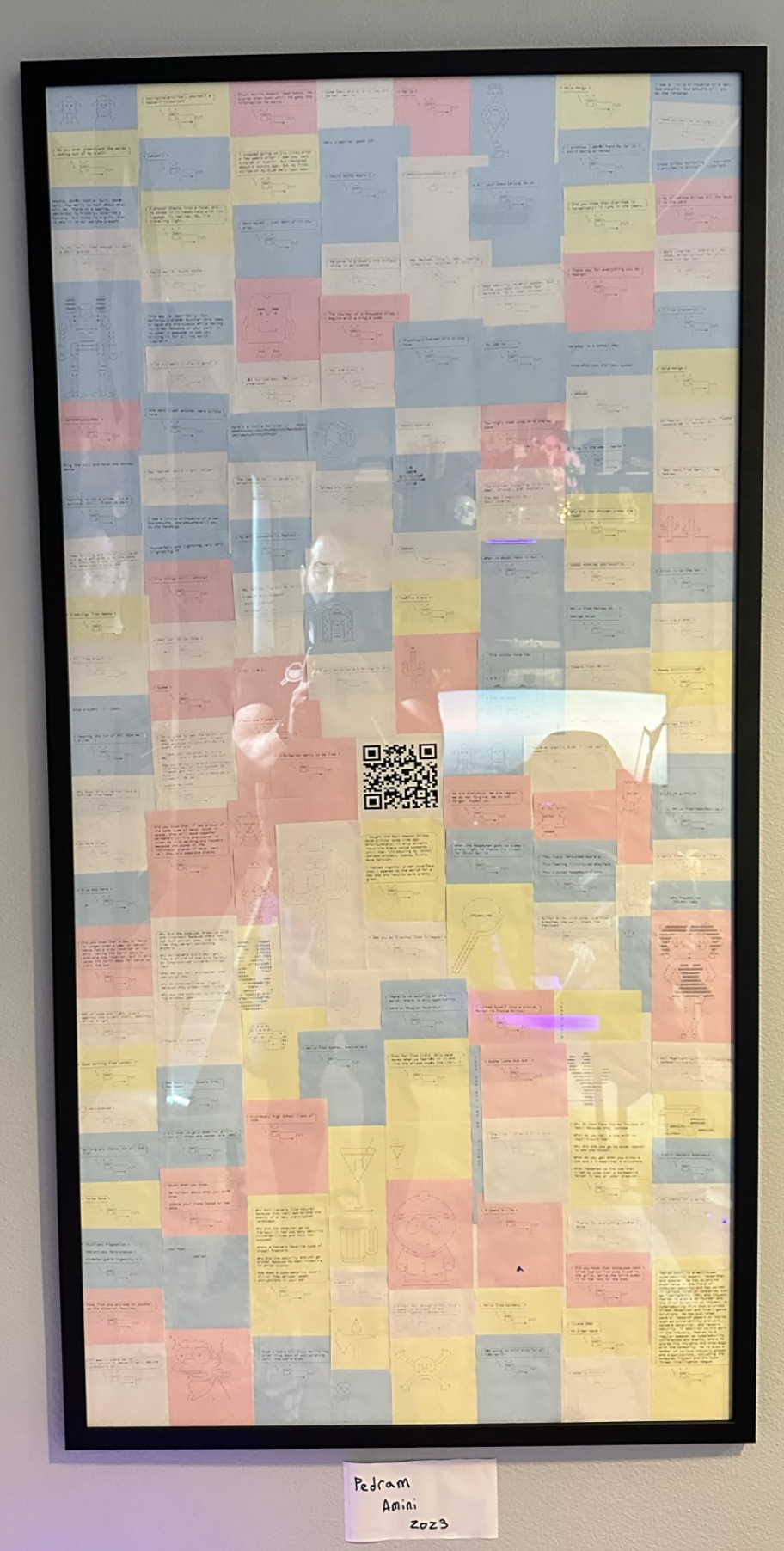
Hack the planet.